The Silence Stages

Since 2005 I have been visiting more than 430 ancient greek and roman theatres around 18 countries, taking photographs and information. These blog is dedicated to all that experience.


Desde 2005 he visitado más de 430 teatros y odeones, griegos y romanos en 18 países, tomando fotografías y recopilando información. Este blog está dedicado a toda esta experiencia.


Wednesday, 9 November 2011

Botrys (Batroun)

BOTRYS (Batroun), ancient Syria, modern Lebanon.
COORDINATES: 34º15’21.50’’N // 35º39’42.27’’E
TIPOLOGY: Roman theatre. Urban.
DATE:
TRANSFORMATIONS:
CAPACITY:
CAVEA: The only existing remains are part of the cavea, probably summa by the diameter of the section.
ORCHESTRA:
STAGE BUILDING:
LOCATION: The remains of the roman theatre are inside a garden of a private house, east of modern Botrys, 60 klm. north of Beirut.
MY BEDSIDE TABLE: Chase, Raymond G. “Ancient Hellenistic and Roman amphitheatres, stadiums and theatres. The way they look now”. Portsmouth, Peter E. Randall Publisher, 2002. // Sear, Frank; “Roman theatres: an architectural study”. Oxford University Press, 2006. // Ciancio Rossetto, Paola; Giuseppina Pisani Sartorio (eds); “Teatri Greci e Romani: alle origini del linguaggio rappresentato”. Rome: SEAT, 1995.


OUT OF PRINT: When I was a child I used to watch Beirut images on tv news, they were images of tanks in a dusty city... for me that was a far world, like a world that lived in another dimension, very far... that images of Lebanon war made me feel strange and restless, but in another way I felt safe for being so far... that was I believed, a very far world, so far that it was impossible for me to be there in my life... so I was safe... Walking by Beirut´s streets you can see today the traces of the war that I watched on tv when I was younger although unfortunately you can see traces of more wars there... so many wars there... I had the luck of travel to Lebanon, of work there doing the best I know to do... thanks to Wallid and Wasim and all the people of the Palestinian refugee camps for teaching me the right meaning of life.

Sunday, 6 November 2011

Grumentum (Grumento Nova)

GRUMENTUM (Grumento Nova), ancient Regio III, modern Italy.

COORDINATES: 40º16’59.77’’N // 15º54’18.98’’E
TIPOLOGY: Roman theatre. Urban.
DATE: First I A.D. (Iulio-Claudian).
TRANSFORMATIONS: Scaena transformed in II – III A.D.
CAPACITY:
CAVEA: Facing north-east. 128 m. diameter. Built on substructures, over two semicircular ambulacrum. It had ima, media and summa cavea.
ORCHESTRA: 32 m. diameter. Two steps for bisellia.
STAGE BUILDING: Proscaenium was 1,2 m. high. Pulpitum 28,8 m. long.
LOCATION: South-west side of old town. 2 klm. east from modern Grumento Nova, in Basilicata.
MY BEDSIDE TABLE: Tosi, Giovana; “Gli edificio per spettacoli nell’Italia romana”. Roma, Quasar, 2003. // Courtois, Catherine; “Le bâtiment de scène des théâtres d’Italie et de Sicile”. Providence, Louvain-la.Neuve, 1989. // Sear, Frank; “Roman theatres: an architectural study”. Oxford University Press, 2006. // Ciancio Rossetto, Paola; Giuseppina Pisani Sartorio (eds); “Teatri Greci e Romani: alle origini del linguaggio rappresentato”. Rome: SEAT, 1995.
 

OUT OF PRINT: Marvelous place with a very big amphitheatre in a short walk from roman theatre, an ancient town far from the bustle of the empire.

Monday, 24 October 2011

Kos (Cos, Cos Island)

KOS (Cos – Cos Island), ancient Asia Minor, modern Greece.

COORDINATES: 36º53’22.64’’N // 27º17’05.18’’E
TIPOLOGY: Roman odeon. Urban.
DATE: II d.C.
TRANSFORMATIONS:
CAPACITY: 750 spectators.
CAVEA: Facing north. It´s inscribed in a rectangle: 31,9 x 26,1 m. Maenianum: Ima cavea with 9 row of seats in 3 cuenei. Summa cavea with probably 5 rows of seats in unknown cunei.
ORCHESTRA: 5,14 m. diameter. It was paved with colour marble.
STAGE BUILDING: Proscaenium was 0,8 m. high. Pulpitum was 10,4 x 3,6 m.
LOCATION: The odeon was built in roman times in the southwest quarter of the city; today is just out of the modern city, close to the peripheral road.
MY BEDSIDE TABLE: Sear, Frank; “Roman theatres: an architectural study”. Oxford University Press, 2006. // Ciancio Rossetto, Paola; Giuseppina Pisani Sartorio (eds); “Teatri Greci e Romani: alle origini del linguaggio rappresentato”. Rome: SEAT, 1995. // Lange, Judith; Bosnakis, Dimitris; “Ancient theatres”. Athens, Itanos, 1996.


OUT OF PRINT: The night before I take that photo I were there listening a concert. It was Vivaldi´s music in an evening that was dismissed the long summer. An odeon was constructed in ancient times for listening music and declamation. And I were there, leaving me encompass the waves of the music, a music that was injured by the counterpoint of the cars outside. It was not easy, but for moments it was possible to feel the odeon bubble, the miracle, its cuddle.

Monday, 17 October 2011

Mevania (Bevagna)

MEVANIA (Bevagna), ancient Regio VI, modern Italy.
 
COORDENATES: 42º56’05.28’’N // 12º36’36.66’’E
TIPOLOGY: Roman theatre. Urban.
DATE: I A.D.
TRANSFORMATIONS:
CAPACITY:
CAVEA: Facing south. 90 m. diameter. It preserves two annular corridors, outer one is the ambulacrum.The street “Via San Francesco” follows cavea outer wall.
ORCHESTRA:
STAGE BUILDING: The street “Corso Matteoti” follows line of scene building.
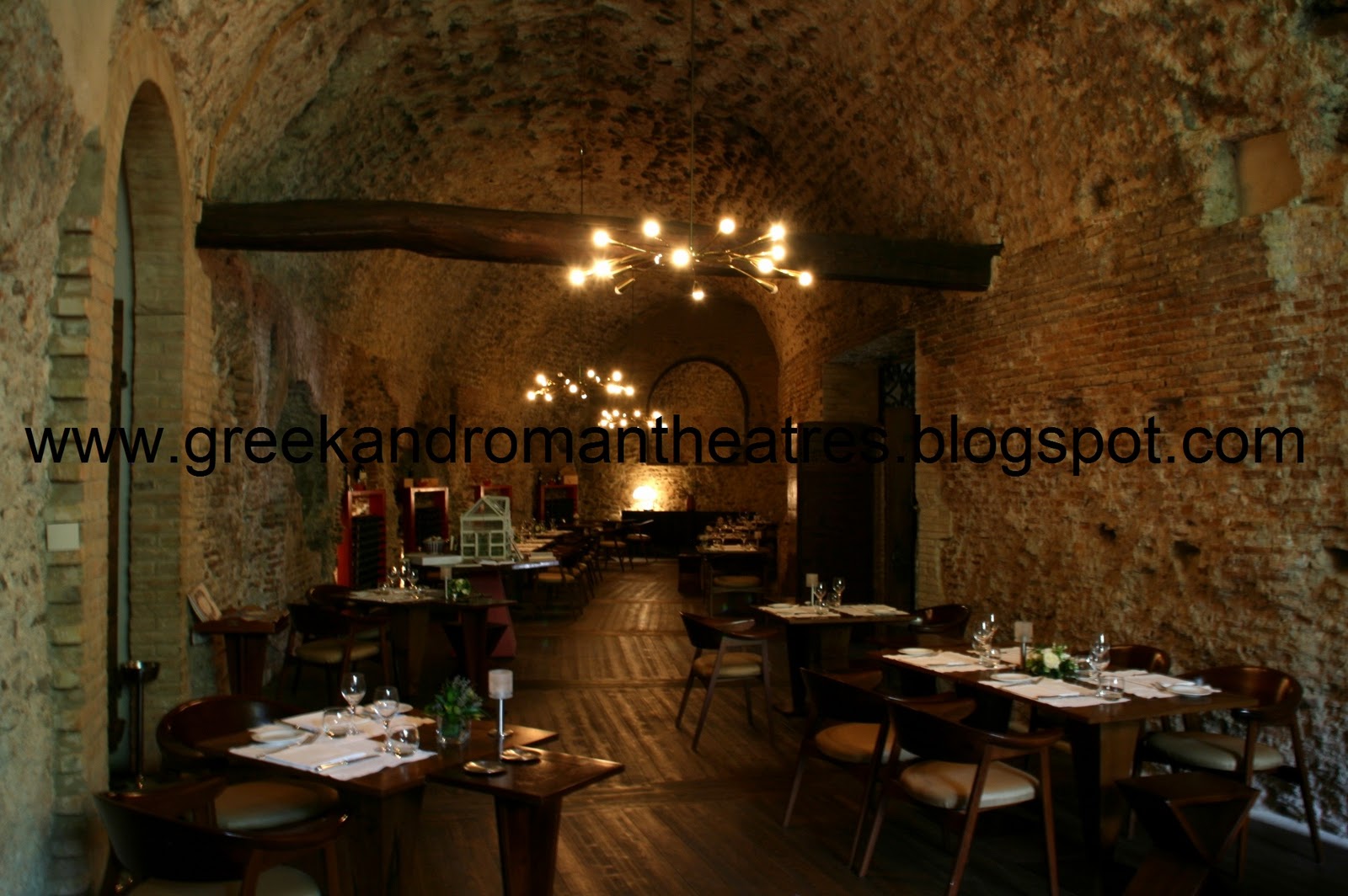
LOCATION: In modern Bevagna. It´s visible in the curve of the buildings and the ambulacrum is Redibis restaurant and a museum now.
MY BEDSIDE TABLE: Tosi, Giovana; “Gli edificio per spettacoli nell’Italia romana”. Roma, Quasar, 2003. // Sear, Frank; “Roman theatres: an architectural study”. Oxford University Press, 2006. // Ciancio Rossetto, Paola; Giuseppina Pisani Sartorio (eds); “Teatri Greci e Romani: alle origini del linguaggio rappresentato”. Rome: SEAT, 1995. http://www.redibis.it/en/home.html


OUT OF PRINT: These theatre is the one I would like to come back with my friend Fran, I am sure he would love it, so dedicated to you, Fran. I have been in theatres that now are an olive grove, or are part of private garden, or are in the meddle of a cornfield or in the meddle of a desert island, or in the corner of a bombed city, I have been in theatres that are underground... but Bevagna one is special... now, the ambulacrum is part of a marvellous restaurant, while you eat its wonderful stew and drink a good wine you can hear through the tunnel of time invisible people getting excited to the next play.

Tuesday, 11 October 2011

Leuke (Kouphonisi Island - Crete)

LEUKE (Kouphonisi Island – Crete), ancient Cyrenaica, modern Greece.

COORDINATES: 34º56’50.94’’N // 26º07’48.19’’E
TIPOLOGY: Roman theatre. Urban.
DATE: Roman empire.
TRANSFORMATIONS: It was destroyed in IV A.D. The theatre was excavated in 1976.
CAPACITY: 1.000 spectators.
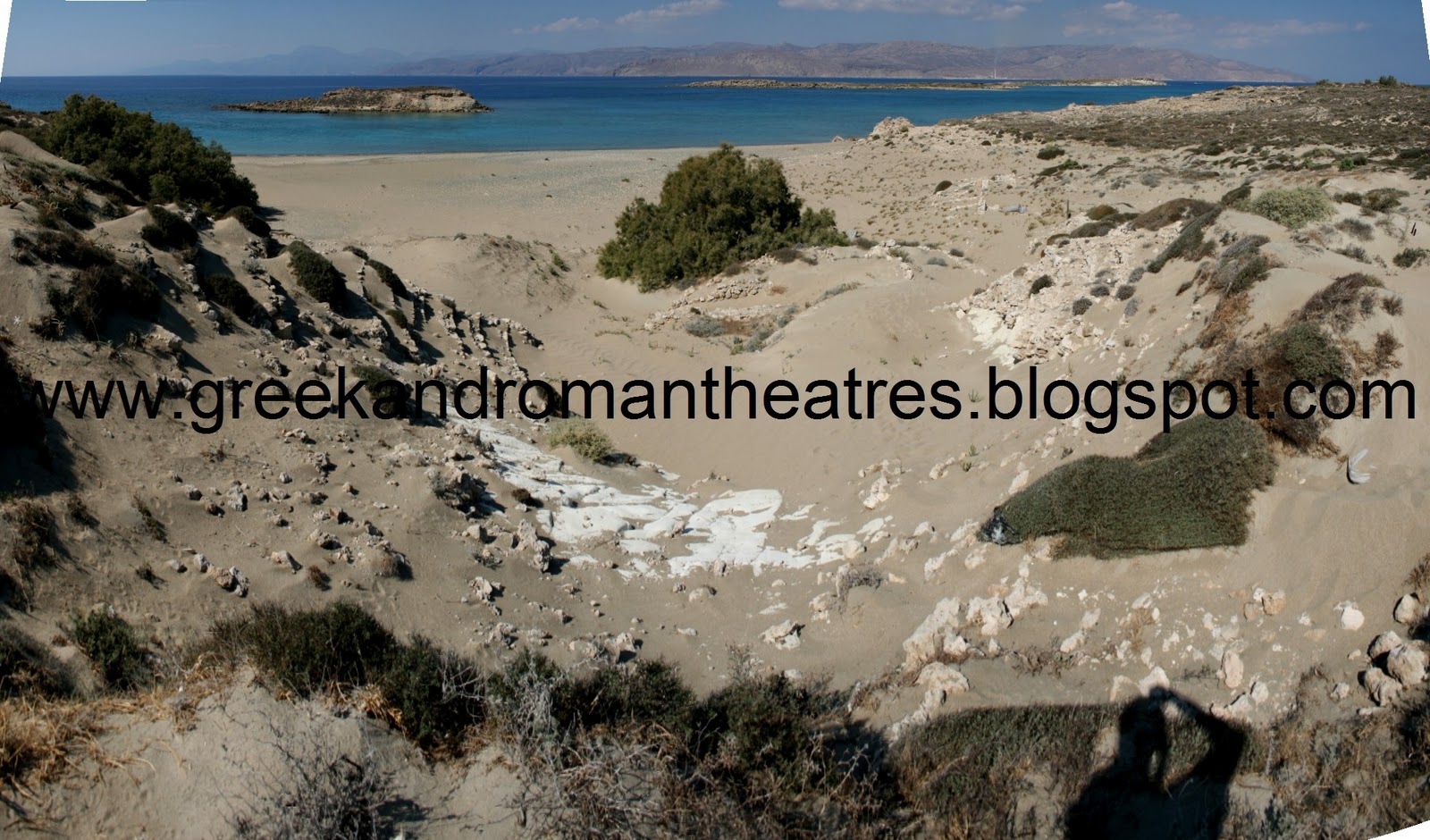
CAVEA: Facing northwest. 12 rows of seats are preserved.
ORCHESTRA: Marble floor preserved.
STAGE BUILDING: Pulpitum preserved, it´s carved on rock.
LOCATION: Ancient Leuke is in Kouphonisi island, an uninhabited island nowadays. Kouphonisi is 18 klm. east from modern Makry Gialos.
MY BEDSIDE TABLE: Sear, Frank; “Roman theatres: an architectural study”. Oxford University Press, 2006. // Ciancio Rossetto, Paola; Giuseppina Pisani Sartorio (eds); “Teatri Greci e Romani: alle origini del linguaggio rappresentato”. Rome: SEAT, 1995.


OUT OF PRINT: What three things would you take with you to a desert island? If that island is Kouphonisi I only would have to take two things... I had the luck of being some days ago in a desert island for a time, a short time but enough for being a lucky Robison, I was left there for a while... A desert island that have a roman theatre, a desert theatre, a desert silence, a silence break down for the breeze of the sea, a silence framed by the sunset... I have never been in such a paradise place like that. Thanks to Giannis who make possible to travel there.