The Silence Stages

Since 2005 I have been visiting more than 430 ancient greek and roman theatres around 18 countries, taking photographs and information. These blog is dedicated to all that experience.


Desde 2005 he visitado más de 430 teatros y odeones, griegos y romanos en 18 países, tomando fotografías y recopilando información. Este blog está dedicado a toda esta experiencia.


Friday, 3 February 2012

Philadelphia (Amman)

PHILADELPHIA (Amman), ancient Arabia, modern Jordan.

COORDINATES: 31º57’08.38’’N // 35º56’23.65’’E
TIPOLOGY: Roman odeon.Urban.
DATE: Half II A.D.
TRANSFORMATIONS:
CAPACITY: 1500 spectators.
CAVEA: Facing west. 38 m. diameter. Maenianum: Ima cavea 10 rows of seats in 4 cunei; Summa cavea with 7 rows in 7 cunei.
ORCHESTRA: 10,75 m. Paved in stone, surrounded by podium.
STAGE BUILDING: Proscaenium was 1,15 m. high. Pulpitum was 22x5,35 m. including proscaenium wall. Scaenae frons was rectilinear.
LOCATION: Close to the Roman theatre.
MY BEDSIDE TABLE: Segal, Arthur; “Theatres in Roman Palestine & provincia Arabia”. New York, E.J. Brill., 1995. // Sear, Frank; “Roman theatres: an architectural study”. Oxford University Press, 2006. // Ciancio Rossetto, Paola; Giuseppina Pisani Sartorio (eds); “Teatri Greci e Romani: alle origini del linguaggio rappresentato”. Rome: SEAT, 1995.


OUT OF PRINT: At the Amman´s roman odeon I lived something that I never had lived anywhere, in my travels through the Middle East. An endless of young people in love going in and out of the odeon, like being in a secret place, a secret place where love leads the steps, chaste love. They lovers coming to the odeon, hand with hand, the sat in the steps, talkink quietly, probably making plans of future, and then go out... that was all, in a continual coming and going, dozens of couples... where were they? You can only see them in the odeon... chaste love. I remember now that verses of an ancient Arab poet, Yamil Butayna: “I ride my eye in the sky / maybe it coincide with hers"

Wednesday, 25 January 2012

Lanuvium (Lanuvio)

LANUVIUM (Lanuvio), ancient Regio I, modern Italy.

COORDINATES: 41º40’31.48’’N // 12º41’50.92’’E
TIPOLOGY: Roman theatre. Not urban.
DATE: Probably I A.D.
TRANSFORMATIONS: Restored in II A.D.
CAPACITY:
CAVEA: Facing north-west. 53,8 m. diameter.  Upper cavea built on radial walls.
ORCHESTRA:
STAGE BUILDING: Proscaenium was 1 m. high, pulpitum 32,7x8-9m. Basilicas 6 m. wide
LOCATION: North corner of medieval fortifications.
MY BEDSIDE TABLE: Tosi, Giovana; “Gli edificio per spettacoli nell’Italia romana”. Roma, Quasar, 2003. // Sear, Frank; “Roman theatres: an architectural study”. Oxford University Press, 2006. // Ciancio Rossetto, Paola; Giuseppina Pisani Sartorio (eds); “Teatri Greci e Romani: alle origini del linguaggio rappresentato”. Rome: SEAT, 1995.


OUT OF PRINT: The ancient theatre remains are under medieval and modern buildings. You have to go inside the hall of the nearby flats to see some walling and parts of the aditus maximi. When I was trying to see something in my private investigation, one man invites me to go into his home, I hardly understood his Italian; he took me to his sitting room and showed me some stone walls from the roman theatre that were the walls of his home, he took me to another part of the house, and i never thought I was going to see what I did... in another room, behind a door, the man took away some books and filing, and suddenly appeared... there was some stone steps of the theatre... can you imagine it, rows of seats from a roman theatre inside your home?

Sunday, 22 January 2012

Rhodes (Rodos)

RHODES (Rodos), ancient Asia Minor, modern Greece.
COORDINATES: 36º26’24.41’’N // 28º12’42.54’’E
TIPOLOGY: Hellenistic odeon.
DATE: Between III – I B.C. Not urban.
TRANSFORMATIONS: Hardly restored in modern times.
CAPACITY: 800 spectators.
CAVEA: Facing east. 29 m. diameter. It has been hardly restored. Maenianum: Ima cavea with 10 rows of seats in 5 cunei; Summa cavea with 9 rows of seats in 4 cunei.
ORCHESTRA: 5,55 m. diammeter.
STAGE BUILDING: There´s not remains, maybe the stage building was on wood.
LOCATION: In the ancient acropolis of Rhodes, west of modern town, close to the ancient stadium.
MY BEDSIDE TABLE: Sear, Frank; “Roman theatres: an architectural study”. Oxford University Press, 2006. // Ciancio Rossetto, Paola; Giuseppina Pisani Sartorio (eds); “Teatri Greci e Romani: alle origini del linguaggio rappresentato”. Rome: SEAT, 1995. // Lange, Judith; Bosnakis, Dimitris; “Ancient theatres”. Athens, Itanos, 1996.


OUT OF PRINT: Baked by the sun, I remembered in Rhode´s odeon one of my favorite poems, i do not know why, maybe because I was in Greece that came to me that lines from Kavafis, maybe because these verses always have been for me pure theater, some material which sometime I would like to work...

“A young man, twenty-eight years of age, Emes arrived
at this little Syrian harbor on a Tenion vessel
with the intention of learning to be a perfume seller.
But during the voyage he fell ill; and as soon
as he disembarked, he died. His burial, the very poorest,
took place here. A few hours before he died,
he murmured something about "home," about "very old parents."
But who they were nobody knew,
nor which his country in the vast panhellenic world.
It is better so. For in this way, though
he lies dead in this little harbor,
his parents will always go on hoping he is alive”

-Konstantin Kavafis-

Thursday, 5 January 2012

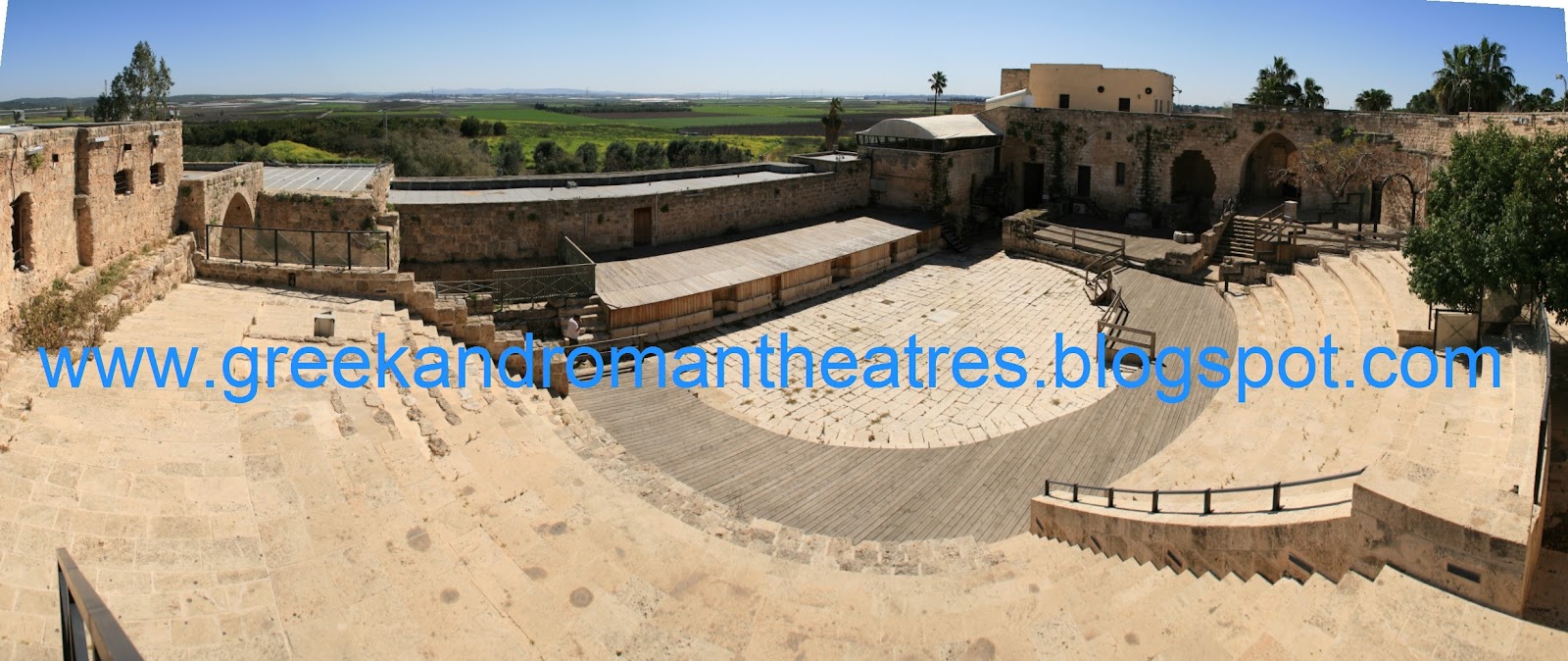
Mamas (Shuni)

MAMAS (Shumi), ancient Arabia, modern Israel.

COORDINATES: 32º32’04.86’’ N // 34º56’53.78’’ E
TIPOLOGY: Roman cult theatre. Not urban.
DATE: II or III A.D.
TRANSFORMATIONS: In byzantine period.
CAPACITY: 1.000 spectators.
CAVEA: Facing east. 60 m. diameter. Probably two maeniana: Ima cavea with probably 11 rows of seats in 4 cunei; summa cavea unknown.
ORCHESTRA: 26 m. diameter including subsellia, without it 19,5 m. diameter.
STAGE BUILDING: Proscaenium had semicircular an rectangular niches. Stage building was 35x10 m. Postcaenium had a pool for ritual purpose.  
LOCATION: 5 klm. north-east from ancient Caesarea. 52 klm. north from Tel Aviv.
MY BEDSIDE TABLE: Segal, Arthur; “Theatres in Roman Palestine & provincia Arabia”. New York, E.J. Brill., 1995. // Sear, Frank; “Roman theatres: an architectural study”. Oxford University Press, 2006. // Ciancio Rossetto, Paola; Giuseppina Pisani Sartorio (eds); “Teatri Greci e Romani: alle origini del linguaggio rappresentato”. Rome: SEAT, 1995.


 OUT OF PRINT: Although the morning I visited Shumi´s ancient theatre it was cold, I do the way of the lizard, looking for the sun in the seats; the hot of the sun always invite me to read, to taste the silences of the book. I remember I was reading a play of a Israeli writer, Hanoch Levin, the play was The Whore from Ohio; not a Plauto´s comedy or a Greek tragedy, but for my personal cosmogony, somehow, after my stay in Israel, Levin is also a classic. I do not know what did the stone steps thought about my reading, maybe they were agree too, but my applause sounded poor for a so beautiful place. I like Hanoch Levin.

Thursday, 8 December 2011

Segesta (Segesta)

 SEGESTA (Segesta), ancient Magna Graecia, modern Italy.

COORDINATES: 37º56’27.86’’N // 12º50’37.89’’E
TIPOLOGY: Greek siceliot theatre.
DATE: End of IV B.C. or half III B.C.
TRANSFORMATIONS: Proscaenium rebuilt in II B.C. Roman reformations.
CAPACITY: 3.200 spectators.
CAVEA: Facing south. 64 m. diameter. Maenianum: Ima cavea with 21 rows of seats in 7 cunei. It is not well known the number of exact rows of seats and cunei from summa cavea. The analemmata converges with the scene building.
ORCHESTRA: 14,8 m. diameter.
STAGE BUILDING: Stage building was 17,7 x 6,1 m. Parascaenia was 4,9 x 9,3 m. Proscaenium with 17,7 x 3,4 m. and 3,3 m. high.
LOCATION: Ancient Segesta is 35 klm. east from Trapani, 65 klm. sout-west drom Palermo.
MY BEDSIDE TABLE: Tosi, Giovana; “Gli edificio per spettacoli nell’Italia romana”. Roma, Quasar, 2003. // Courtois, Catherine; “Le bâtiment de scène des théâtres d’Italie et de Sicile”. Providence, Louvain-la.Neuve, 1989. // Sear, Frank; “Roman theatres: an architectural study”. Oxford University Press, 2006. // Ciancio Rossetto, Paola; Giuseppina Pisani Sartorio (eds); “Teatri Greci e Romani: alle origini del linguaggio rappresentato”. Rome: SEAT, 1995.


 OUT OF PRINT: In the ancient settlement of Segesta you can find an impressive ancient temple and the marvelous ancient theatre. The theatre is up in a hill, the temple is 700 m. down. I would like to have known ancient Segesta people, for a simple way they knew how to honor Gods, built the theatre in the higher place, displacing the temple, knowing perfectly what kind of ritual Gods wanted, the ritual of ancient drama.