The Silence Stages

Since 2005 I have been visiting more than 430 ancient greek and roman theatres around 18 countries, taking photographs and information. These blog is dedicated to all that experience.


Desde 2005 he visitado más de 430 teatros y odeones, griegos y romanos en 18 países, tomando fotografías y recopilando información. Este blog está dedicado a toda esta experiencia.


Showing posts with label Greece / Islands. Show all posts

Wednesday, 8 May 2013

Lindus (Lindos)

LINDUS (Lindos –Rhodes Island), ancient Asia Minor, modern Greece.

COORDINATES: 36º05´23.55’’N // 28º05’13.38’’E
TIPOLOGY: Greek theatre. Urban.
DATE: IV B.C.
TRANSFORMATIONS:
CAPACITY:
CAVEA: Built against hillside, rock cut. Facing west-south west. 45m. diameter. exceeds semicircle. Maenianum: Ima cavea with 19 rows of seats in 9 cunei; summa cavea probably with 6 rows in 3 cunei.
ORCHESTRA: 14 m. diameter.
STAGE BUILDING: Scene building was 19x4,8 m.
LOCATION: East of modern Lindos, on Acropolis hill.
MY BEDSIDE TABLE: Sear, Frank; “Roman theatres: an architectural study”. Oxford University Press, 2006.// Ciancio Rossetto, Paola; Giuseppina Pisani Sartorio (eds); “Teatri Greci e Romani: alle origini del linguaggio rappresentato”. Rome: SEAT, 1995. // Arias, Paolo Enrico; “Il teatro greco fuori di Atene”. Firenze, G.C. Sansoni, 1934.


OUT OF PRINT: I do not cross Mediterranean sea for being near, I try and try to search the way to be close, although shadows dogs try to discourage me. Always I wanted to be in that theatre, when I were there I knew why... all the words reject...

Sunday, 4 November 2012

Delos (Dilos Island)

DELOS (DILOS), ancient Achaia, modern Cyclades, Greece.

COORDINATES: 3Gº23’52.96’’N // 25º16’14.96’’E
TIPOLOGY: Cultic greek theatre. Urban. It´s not the big theatre in Delos, is the small one associated to the Sanctuary of the Syrian gods.
DATE: Last II B.C.
TRANSFORMATIONS:
CAPACITY: 500 spectators.
CAVEA: Facing west. Built against hillside, 20,6 m. diameter. Cavea exceeds semicircle. Maenianum: 12 rows of seats in 5 cunei.
ORCHESTRA: 10,6 m. diameter, paved in mosaic.
STAGE BUILDING: there´s not traces. Probably never had.
LOCATION: The theatre is in Delos island, south-east in the ancient city; the theatre is part of the Syrian gods sanctuary, 0,25 kllm. north-east from the big Greek theatre.
MY BEDSIDE TABLE: Nielsen, Inge. “Cultic theatre and ritual drama”. Aarhus, Aarhus University Press, 2002. // Sear, Frank; “Roman theatres: an architectural study”. Oxford University Press, 2006.// Ciancio Rossetto, Paola; Giuseppina Pisani Sartorio (eds); “Teatri Greci e Romani: alle origini del linguaggio rappresentato”. Rome: SEAT, 1995.
 
 
OUT OF PRINT: The theatre did not belong to the sanctuary originaly, but was constructed in the enlargement carried out in 113-104 B.C.

Friday, 5 October 2012

Thera (Thira, Santorini Island)


THERA (Thira, Santorini Island, Cyclades), ancient Achaea, modern Greece.

COORDINATES: 36º21’47.99’’N // 25º28’43.72’’E
TIPOLOGY: Greek theatre. Urban.
DATE: First half III B.C.
TRANSFORMATIONS: Presesent stone cavea at half II B.C. Roman scaena at Tiberian time, I A.D.
CAPACITY: 1.500 spectators.
CAVEA: Facing east-north-east. Cavea is enclosed in rectangular walls. Ima cavea with 23 rows of seats in 5 cunei.
ORCHESTRA: Circular orchestra, 9,58 m. diameter.
STAGE BUILDING: The front wall of Roman scene building was built on line of Hellenistic proscaenium wall.
LOCATION: The theatre is south-east of the ancient remains. Ancient Thera is located at east of Santorini island, in the Cyclades.
MY BEDSIDE TABLE: Sear, Frank; “Roman theatres: an architectural study”. Oxford University Press, 2006.// Ciancio Rossetto, Paola; Giuseppina Pisani Sartorio (eds); “Teatri Greci e Romani: alle origini del linguaggio rappresentato”. Rome: SEAT, 1995. // Arias, Paolo Enrico; “Il teatro greco fuori di Atene”. Firenze, G.C. Sansoni, 1934.


OUT OF PRINT:
“They will smell of incense, and their faces are burnt by their crossing through the great dark places”. –The sleep of the brave- Odysseas Elytis.

Friday, 27 April 2012

Lato (Gulas)


LATO (Gulas), ancient Cyrenaica, modern Creta, Grece.

COORDINATES: 35º10’42.77’’N // 25º39’20.31’’E
TIPOLOGY: Theatron. Archaic cult Greek theatre. Urban
DATE: End IV B.C.
TRANSFORMATIONS:
CAPACITY: 180 spectators.
CAVEA: Facing South. Rectilinear. Theatron is 8 m. long. One maeniana with 10 rows of seats in 3 cunei. The structure has two missions, being a theatron and steps for reaching the upper city.
ORCHESTRA:
STAGE BUILDING:
LOCATION: Ancient Lato is 10 klm south-west from modern Aghios Nikolaos.
MY BEDSIDE TABLE: Nielsen, Inge. “Cultic theatre and ritual drama”. Aarhus, Aarhus University Press, 2002. // Anti, Carlo. “Teatri greci arcaici”. Roma, L’Erma di Bretschneider, 1947. // Sear, Frank; “Roman theatres: an architectural study”. Oxford University Press, 2006. // Ciancio Rossetto, Paola; Giuseppina Pisani Sartorio (eds); “Teatri Greci e Romani: alle origini del linguaggio rappresentato”. Rome: SEAT, 1995.


OUT OF PRINT: Lato has two rectilinear theatron. These one is in the agora, looking to prytaneion, the other one is in the south.

Sunday, 22 January 2012

Rhodes (Rodos)

RHODES (Rodos), ancient Asia Minor, modern Greece.
COORDINATES: 36º26’24.41’’N // 28º12’42.54’’E
TIPOLOGY: Hellenistic odeon.
DATE: Between III – I B.C. Not urban.
TRANSFORMATIONS: Hardly restored in modern times.
CAPACITY: 800 spectators.
CAVEA: Facing east. 29 m. diameter. It has been hardly restored. Maenianum: Ima cavea with 10 rows of seats in 5 cunei; Summa cavea with 9 rows of seats in 4 cunei.
ORCHESTRA: 5,55 m. diammeter.
STAGE BUILDING: There´s not remains, maybe the stage building was on wood.
LOCATION: In the ancient acropolis of Rhodes, west of modern town, close to the ancient stadium.
MY BEDSIDE TABLE: Sear, Frank; “Roman theatres: an architectural study”. Oxford University Press, 2006. // Ciancio Rossetto, Paola; Giuseppina Pisani Sartorio (eds); “Teatri Greci e Romani: alle origini del linguaggio rappresentato”. Rome: SEAT, 1995. // Lange, Judith; Bosnakis, Dimitris; “Ancient theatres”. Athens, Itanos, 1996.


OUT OF PRINT: Baked by the sun, I remembered in Rhode´s odeon one of my favorite poems, i do not know why, maybe because I was in Greece that came to me that lines from Kavafis, maybe because these verses always have been for me pure theater, some material which sometime I would like to work...

“A young man, twenty-eight years of age, Emes arrived
at this little Syrian harbor on a Tenion vessel
with the intention of learning to be a perfume seller.
But during the voyage he fell ill; and as soon
as he disembarked, he died. His burial, the very poorest,
took place here. A few hours before he died,
he murmured something about "home," about "very old parents."
But who they were nobody knew,
nor which his country in the vast panhellenic world.
It is better so. For in this way, though
he lies dead in this little harbor,
his parents will always go on hoping he is alive”

-Konstantin Kavafis-

Monday, 24 October 2011

Kos (Cos, Cos Island)

KOS (Cos – Cos Island), ancient Asia Minor, modern Greece.

COORDINATES: 36º53’22.64’’N // 27º17’05.18’’E
TIPOLOGY: Roman odeon. Urban.
DATE: II d.C.
TRANSFORMATIONS:
CAPACITY: 750 spectators.
CAVEA: Facing north. It´s inscribed in a rectangle: 31,9 x 26,1 m. Maenianum: Ima cavea with 9 row of seats in 3 cuenei. Summa cavea with probably 5 rows of seats in unknown cunei.
ORCHESTRA: 5,14 m. diameter. It was paved with colour marble.
STAGE BUILDING: Proscaenium was 0,8 m. high. Pulpitum was 10,4 x 3,6 m.
LOCATION: The odeon was built in roman times in the southwest quarter of the city; today is just out of the modern city, close to the peripheral road.
MY BEDSIDE TABLE: Sear, Frank; “Roman theatres: an architectural study”. Oxford University Press, 2006. // Ciancio Rossetto, Paola; Giuseppina Pisani Sartorio (eds); “Teatri Greci e Romani: alle origini del linguaggio rappresentato”. Rome: SEAT, 1995. // Lange, Judith; Bosnakis, Dimitris; “Ancient theatres”. Athens, Itanos, 1996.


OUT OF PRINT: The night before I take that photo I were there listening a concert. It was Vivaldi´s music in an evening that was dismissed the long summer. An odeon was constructed in ancient times for listening music and declamation. And I were there, leaving me encompass the waves of the music, a music that was injured by the counterpoint of the cars outside. It was not easy, but for moments it was possible to feel the odeon bubble, the miracle, its cuddle.

Tuesday, 11 October 2011

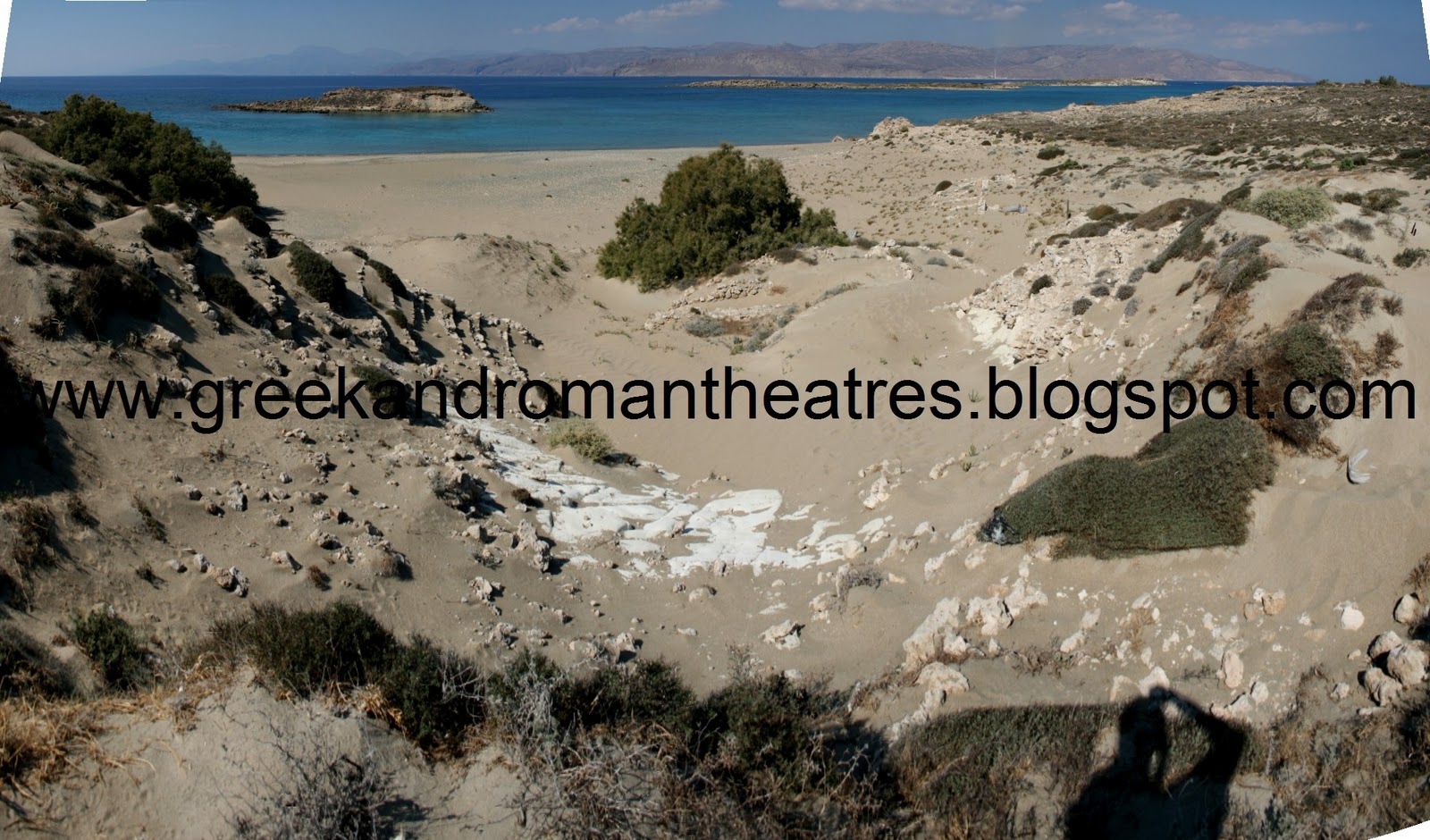
Leuke (Kouphonisi Island - Crete)

LEUKE (Kouphonisi Island – Crete), ancient Cyrenaica, modern Greece.

COORDINATES: 34º56’50.94’’N // 26º07’48.19’’E
TIPOLOGY: Roman theatre. Urban.
DATE: Roman empire.
TRANSFORMATIONS: It was destroyed in IV A.D. The theatre was excavated in 1976.
CAPACITY: 1.000 spectators.
CAVEA: Facing northwest. 12 rows of seats are preserved.
ORCHESTRA: Marble floor preserved.
STAGE BUILDING: Pulpitum preserved, it´s carved on rock.
LOCATION: Ancient Leuke is in Kouphonisi island, an uninhabited island nowadays. Kouphonisi is 18 klm. east from modern Makry Gialos.
MY BEDSIDE TABLE: Sear, Frank; “Roman theatres: an architectural study”. Oxford University Press, 2006. // Ciancio Rossetto, Paola; Giuseppina Pisani Sartorio (eds); “Teatri Greci e Romani: alle origini del linguaggio rappresentato”. Rome: SEAT, 1995.


OUT OF PRINT: What three things would you take with you to a desert island? If that island is Kouphonisi I only would have to take two things... I had the luck of being some days ago in a desert island for a time, a short time but enough for being a lucky Robison, I was left there for a while... A desert island that have a roman theatre, a desert theatre, a desert silence, a silence break down for the breeze of the sea, a silence framed by the sunset... I have never been in such a paradise place like that. Thanks to Giannis who make possible to travel there.

Sunday, 5 June 2011

Eretria (Eretria)

ERETRIA (Eretria, Eubea island), ancient Euboea / Achaea, modern Greece.

COORDINATES: 38º23’54.93’’N // 23º47’26.48’’E
TIPOLOGY: Greek theatre.
DATE: First half V B.C.
TRANSFORMATIONS: First cavea was rebuilt in last IV B.C. Scene building rebuilt in last II B.C.
CAPACITY: 6.300 spectators.
CAVEA: Facing south. 91 m. diameter. It had 25 row of seats but only 8 are preserved, divided in 11 cunei.
ORCHESTRA: 22 m. diameter. There are a Charonian corridor from under the stage to the meddle of the orchestra, it was used for special appearances in the middle of the play, including appearances of characters from the underworld.
STAGE BUILDING: The stage was 19,8 x 2,7 m. It survives remains of early scene building,  that was divided in five rooms. The scene wall in the second period was 25,6 m. long. In third period the old parascaenia was removed and a new scene building was built.
LOCATION: Eretria´s ancient theatre is close to modern Eretria, in Eubea island.
MY BEDSIDE TABLE: Sear, Frank; “Roman theatres: an architectural study”. Oxford University Press, 2006. // Ciancio Rossetto, Paola; Giuseppina Pisani Sartorio (eds); “Teatri Greci e Romani: alle origini del linguaggio rappresentato”. Rome: SEAT, 1995. // Bieber, Margarete. “The History of The Greek and Roman Theatre”. Princeton University Press, 1961. // Neppi Modona, Aldo. “Gli edificio teatrali greci e romani”. Firenze, Leo S. Olschki, 1961. // Lange, Judith; Bosnakis, Dimitris; “Ancient theatres”. Athens, Itanos, 1996. // Maximos, Platon; “Ancient Hellenic theatres”. Athens, 1998. // Maximos, Platon; “Fair competition: ancient stadia – ancient theatres”, Athens,  , 2004. // Arias, Paolo Enrico; “Il teatro greco fuori di Atene”. Firenze, G.C. Sansoni, 1934.


OUT OF PRINT: Dawning. In the slow summer. A cock hoarse and the wild yellow grass, sleepy, fluffy, inviting to a dream that was not yet possible. An elderly woman carrying some vegetables. Some workers with the first cigarette of the day. Eretria stretches in front of this languid colossus, its theatre, to whom I nail my knees

Saturday, 8 January 2011

Melos (Milo)

MELOS (Milo), ancient Achaea, modern Ciclades, Greece.

COORDNATES: 36º44'15.82" N // 24º25'16.09 E
TIPOLOGY : Greek theatre. Urban.
DATE:  III or II B.C.
TRANSFORMATIONS: Shows signs of Roman phase, II A.D. , orchestra and stage building.
CAPACITY: 2.500 ¿? espectators.
CAVEA: Bill against slope. Facing south. Maenianum unknow although Ima cavea has 7 cunei and 9 rows of seats still survives. Four seats shows inscriptions in which you can read that the seats were reserved for some categories of citizens.
ORCHESTRA: 27 m. diameter.
STAGE BUILDING: Some elements of roman scaenae frons survives.
LOCATION: 1 klm. From modern Milos, in the road to Klima´s port.
BEDSIDE TABLE: Sear, Frank; “Roman theatres: an architectural study”. Oxford University Press, 2006. // Lange, Judith; Bosnakis, Dimitris; “Ancient theatres”. Athens, Itanos, 1996.


OUT OF PRINT: The theatre was discovered in 1814, it is close to the place where the famous Venus of Milo was found. Milo is a Ciclades island, a very pacefull place for a rest, with a lot of magic places where the time seems to have stoped, like Sarakiniko´s lunar scenary or Thiorixeia´s red beach with his sulphur mine, a spontaneous industrial art cementery.