The Silence Stages

Since 2005 I have been visiting more than 430 ancient greek and roman theatres around 18 countries, taking photographs and information. These blog is dedicated to all that experience.


Desde 2005 he visitado más de 430 teatros y odeones, griegos y romanos en 18 países, tomando fotografías y recopilando información. Este blog está dedicado a toda esta experiencia.


Showing posts with label Italy. Show all posts

Thursday, 24 July 2014

Casinum (Cassino)


CASINUM (Cassino), ancient Regio I, modern Italy.
 
COORDINATES: 41º28’59.78’’N // 13º49’15.79’’E
TIPOLOGY: Roman theatre. Urban.
DATE: First I A.D.
TRANSFORMATIONS: Scene building rebuilt in second half of I A.D. It was restored in II A.D. First III A.D. the orchestra was transformed in arena.
CAPACITY: 2.000 spectators.
CAVEA: Facing south-east. 53.5 m. diameter. Built against hillside. Maenianum: Ima cavea with 11 rows of seats in 4 cunei; media cavea with 6 rows; summa cavea with 3 rows of seats.
ORCHESTRA: 16,9 m. diameter. Paved in marble, surrounded by wall (diameter at wall 14,6 m.) 3 steps for bisellia.
STAGE BUILDING: Proscaenium had 5 curved and 4 rectangular niches, with 2 staircases. There are aulaeum remains. Pulpitum was 35,7 x 6,2. Scaenae frons was rectilinear in first times, but later it was transformed and was built a curved niche built around regia door. Columnatio with 2 storeys
LOCATION: Close to the center of the ancient town, up of the hill of modern Cassino. The theatre is west from the amphitheatre.
MY BEDSIDE TABLE: Sear, Frank; “Roman theatres: an architectural study”. Oxford University Press, 2006.// Ciancio Rossetto, Paola; Giuseppina Pisani Sartorio (eds); “Teatri Greci e Romani: alle origini del linguaggio rappresentato”. Rome: SEAT, 1995 // Tosi, Giovana; “Gli edificio per spettacoli nell’Italia romana”. Roma, Quasar, 2003. // Courtois, Catherine; “Le bâtiment de scène des théâtres d’Italie et de Sicile”. Providence, Louvain-la.Neuve, 1989.


OUT OF PRINT: El teatro de Casino fue mi primera estación en el Via Crucis de los teatros antiguos de Lazio y Campania. En cada uno de los que pertenecen a un conjunto arqueológico visitable, tuve que justificar mis intereses académicos para poder hacer una miserable fotografía. Aún me cuesta comprender ese recelo, como si fuera posible esconder en una cajita los restos en campo abierto. Primera etapa de un Via Crucis en despachos de funcionarios, rellenando formularios, cuando lo único que quería era convertirme en lagartija y tostarme al sol, en silencio, en las ardientes gradas.

Friday, 19 April 2013

Libarna (Serravalle Scrivia)


LIBARNA (Serravalle Scrivia), ancient Regio IX, modern Italy.

COORDINATES: 44º42’24.31’’N // 8º51’54.08’’E
TIPOLOGY: Roman theatre. Urban.
DATE: Last I first II A.D.
TRANSFORMATIONS: III A.D.
CAPACITY: 3.800 spectators.
CAVEA: Facing north-east. 57,7 m. diameter
ORCHESTRA: 15 m. diameter.
STAGE BUILDING: There are slot visible from aulaeum. Pulpitum was 35 x 4,7 m.
LOCATION: West of the ancient city. The ancient city is 1,5 klm south from modern Serravalle Scrivia, about 50 klm. north from Genova.
MY BEDSIDE TABLE: Sear, Frank; “Roman theatres: an architectural study”. Oxford University Press, 2006. // Ciancio Rossetto, Paola; Giuseppina Pisani Sartorio (eds); “Teatri Greci e Romani: alle origini del linguaggio rappresentato”. Rome: SEAT, 1995. // Tosi, Giovana; “Gli edificio per spettacoli nell’Italia romana”. Roma, Quasar, 2003. / Courtois, Catherine; “Le bâtiment de scène des théâtres d’Italie et de Sicile”. Providence, Louvain-la.Neuve, 1989.
 

OUT OF PRINT: The morning I visited Libarna I had a bigger pleasure than visiting the ancient theatre... I eat the best crostata I have ever eaten... marvelous pleasure for levitate... I can not forget it, you can taste it in “Il Fornio”.

Tuesday, 29 January 2013

Teate Marrucinorum (Chieti)


TEATE MARRUCINORUM (Chieti), ancient Regio IV, modern Italy.

COORDENATES: 42º20’49.18’’N // 14º09’48.21’’E
TIPOLOGY: Roman theatre. Urban.
DATE: Second half of I A.D. or first II A.D.
TRANSFORMATIONS: Orchestra was transformed in colimbetra for water games.
CAPACITY:
CAVEA: Facing north-north-west. 84 m. diameter. Built against slope the centre of cavea.
ORCHESTRA:
STAGE BUILDING: Under modern buildings.
LOCATION: In south-west part of town.
MY BEDSIDE TABLE: Tosi, Giovana; “Gli edificio per spettacoli nell’Italia romana”. Roma, Quasar, 2003.// Sear, Frank; “Roman theatres: an architectural study”. Oxford University Press, 2006.// Ciancio Rossetto, Paola; Giuseppina Pisani Sartorio (eds); “Teatri Greci e Romani: alle origini del linguaggio rappresentato”. Rome: SEAT, 1995.


OUT OF PRINT: If you pretend to find some columnatio in the  scaenae frons you will find clothes drying in the sun, anyway I have always thought both are pretty.

Thursday, 27 December 2012

Iulia Concordia Sagittaria (Concordia Sagittaria)

IULIA CONCORDIA SAGITTARIA (Concordia Sagittaria), ancient Regio X, modern Italy.

COORDENATES: 45º45’31.93’’N // 12º50’26.10’’E
TIPOLOGY: Roman theatre. Urban.
DATE: I A.D.
TRANSFORMATIONS: Scaenae frons reformed in last I A.D.
CAPACITY:
CAVEA: Facing east south-east. 80 m. diameter. Maenianum: Ima cavea with 16 rows of seats; summa cavea: ?
ORCHESTRA: It was transformed for amphitheatre games.
STAGE BUILDING: Proscaenium was rectilinear. Porticus post scaenam traces found.
LOCATION: The place of the ancient Roman theatre is west of Concordia Sagittaria, 60 klm. south-west from Udine.
MY BEDSIDE TABLE: Tosi, Giovana; “Gli edificio per spettacoli nell’Italia romana”. Roma, Quasar, 2003. // Sear, Frank; “Roman theatres: an architectural study”. Oxford University Press, 2006.// Ciancio Rossetto, Paola; Giuseppina Pisani Sartorio (eds); “Teatri Greci e Romani: alle origini del linguaggio rappresentato”. Rome: SEAT, 1995.
OUT OF PRINT: Also nowadays there´s not visible remains of the Roman theatre, in 1879 excavations revealed some traces;one century later, in 1980, new excavations reveled part of the scaena wall. Nothing visible today, but special for me, iConcordia Sagittaria was the first “theatre” I visited in my four travels to Italy

Friday, 19 October 2012

Arretium (Castelsecco / Arezzo)

ARRETIUM (Castelsecco / San Cornelio / Arezzo), ancient Regio VII, modern Italy.

COORDINATES: 43º26’40.98’’N // 11º54’00.93’’E
TIPOLOGY: Roman cultic theatre. Not urban.
DATE: II B.C.
TRANSFORMATIONS:
CAPACITY:
CAVEA: facing south-west, 45 m. diameter. There are remains of 4 lowest rows of seats, now covered.
ORCHESTRA: 12,5 m. diameter, paved in stone slabs.
STAGE BUILDING: Proscaenium was rectilinear, also the scaenae frons. Pulpitum was 18 x 6,5 m.
LOCATION: The theatre is connected with temple, 105 m. away, in the hill of Castelsecco, san Cornelio, 4 klm. south from modern Arezzo.
MY BEDSIDE TABLE: Tosi, Giovana; “Gli edificio per spettacoli nell’Italia romana”. Roma, Quasar, 2003. // Sear, Frank; “Roman theatres: an architectural study”. Oxford University Press, 2006.// Ciancio Rossetto, Paola; Giuseppina Pisani Sartorio (eds); “Teatri Greci e Romani: alle origini del linguaggio rappresentato”. Rome: SEAT, 1995.
 
  
OUT OF PRINT: When I visited the place I was not sure that the theatre were there, I was not sure I was in the right place... but it was, I could check it months later, checking some plans.

Friday, 12 October 2012

Asisium (Assisi)


ASISIUM (Assisi), ancient Regio VI, modern Italy.

COORDINATES: 43º04’13.46’’N // 12.37’05.76’’E
TIPOLOGY: Roman theatre. Urban.
DATE: First I A.D.
TRANSFORMATIONS:
CAPACITY:
CAVEA: Facing south-east. 60 m. diameter. Built on radial vaults, surrounded by ambulacrum. Only some arches survives in a garden close to Via del Torrione, the facade had 23 arched openings. It probably had two maeniana.
ORCHESTRA:
STAGE BUILDING: Close to town walls, under Via del Torrione and Vicolo Bovi.
LOCATION: The theatre remains are 120 m. east from ancient amphitheatre, between Via del Torrione and Via Montecavallo, close to Cattedrale.
MY BEDSIDE TABLE: Tosi, Giovana; “Gli edificio per spettacoli nell’Italia romana”. Roma, Quasar, 2003.// Sear, Frank; “Roman theatres: an architectural study”. Oxford University Press, 2006.// Ciancio Rossetto, Paola; Giuseppina Pisani Sartorio (eds); “Teatri Greci e Romani: alle origini del linguaggio rappresentato”. Rome: SEAT, 1995.


OUT OF PRINT: Sometimes the imagination is fed by small elements to reconstruct somenthing big, an exrcise approaching to the past, playing tracks, holding a straw.

Thursday, 4 October 2012

Praeneste (Palestina)


PRAENESTE (Palestrina), ancient Regio I, Latium, Italy.

COORDINATES: 41º50’25.52’’N // 12º53’33.27’’E
TIPOLOGY: Roman theatrical steps.
DATE: II B.C.
TRANSFORMATIONS:
CAPACITY: 300 spectators.
CAVEA: Facing south-south west. 59 m. diameter. Only one maeniana, with 9 rows of seats. Porticus at summa cavea.
ORCHESTRA:
STAGE BUILDING: The scene was made on wood
LOCATION: The theatre is part of sanctuary of Fortuna Primigenia, in modern Palestrina, 35 klm. east from Rome.
MY BEDSIDE TABLE: Hanson, John Arthur. “Roman theatre-temples”. Princenton, Princenton University Press, 1959. // Tosi, Giovana; “Gli edificio per spettacoli nell’Italia romana”. Roma, Quasar, 2003 // Sear, Frank; “Roman theatres: an architectural study”. Oxford University Press, 2006. // Ciancio Rossetto, Paola; Giuseppina Pisani Sartorio (eds); “Teatri Greci e Romani: alle origini del linguaggio rappresentato”. Rome: SEAT, 1995.
 

 OUT OF PRINT:
“Everyone is alone at the heart of the earth
pierced by a ray of sunlight:
and suddenly it´s evening”

                                         -Salvatore Quasimodo-

Friday, 6 July 2012

Brixia (Brescia)

BRIXIA (Brescia), ancient Regio X, modern Italy.

COORDINATES: 45º32’23.79’’N // 10º13’35.67’’E-
TIPOLOGY: Roman theatre. Urban.
DATE: First III A.D.
TRANSFORMATIONS:
CAPACITY:
CAVEA: Facing south. Built against hillside. 86 m. diameter including outer wall that not complete the semicircle.
ORCHESTRA: 24 m. diameter.
STAGE BUILDING: Proscaenium 1,25 m. high. There´s aulaeum remains (10 holes). Pulpitum 49 x 9,3 including proscaenium wall. Scaenae frons had three doors enclosed in niches with curved sides and flat backs.
LOCATION: Close to Capitilium and Foro.
MY BEDSIDE TABLE: Tosi, Giovana; “Gli edificio per spettacoli nell’Italia romana”. Roma, Quasar, 2003.// Sear, Frank; “Roman theatres: an architectural study”. Oxford University Press, 2006.// Ciancio Rossetto, Paola; Giuseppina Pisani Sartorio (eds); “Teatri Greci e Romani: alle origini del linguaggio rappresentato”. Rome: SEAT, 1995. // “Teatri antichi nell’area del Mediterraneo”. Palermo, I Quaderni di Palazzo Montalbo, 2004.


OUT OF PRINT: I found Brescia´s Roman theatre in silence, an early Sunday morning, nobody in the streets, only a whisper cradling the big theatre ruin that made me remembered Giussepe Ungaretti´s verses: “The sun kidnaps the city / it doesn´t look yet / even the tombs do not resist much”

Tuesday, 1 May 2012

Augusta Praetoria (Aosta)

AUGUSTA PRAETORIA (Aosta), ancient Regio XI, modern Italy.
 
COORDINATES: 45º44’18.83’’N // 7º19’20.42’’E
TIPOLOGY: Roman theatre.
DATE: First I A.D.
TRANSFORMATIONS:
CAPACITY: 4.000 spectators.
CAVEA: Facing Nort-Northwest. 59,6 m. diameter. It´s not known how was exactly the maenianum, buy rows in ima were divided in 3 cunei.
ORCHESTRA: 18,8 m diameter including bisellia (12,7 m.)
STAGE BUILDING: The scaenae frons is very well preserved, one of the best in the ancient world; it´s rectilinear and had two storeys. Proscaenium with 3 curved and 2 rectangular niches; there’s aulaeum remains. Pulpitum was 45,5x6,9 m.-8,45 including proscaenium-.
LOCATION: The ancient theatre is in Aosta old town. 120 klm. north from Torino.
MY BEDSIDE TABLE: Tosi, Giovana; “Gli edificio per spettacoli nell’Italia romana”. Roma, Quasar, 2003. // Courtois, Catherine; “Le bâtiment de scène des théâtres d’Italie et de Sicile”. Providence, Louvain-la.Neuve, 1989. // Sear, Frank; “Roman theatres: an architectural study”. Oxford University Press, 2006. // Ciancio Rossetto, Paola; Giuseppina Pisani Sartorio (eds); “Teatri Greci e Romani: alle origini del linguaggio rappresentato”. Rome: SEAT, 1995. // Izenour, George. Roofed Theaters of Classical Antiquity. Yale University Press, 1992. // “Teatri antichi nell’area del Mediterraneo”. Palermo, I Quaderni di Palazzo Montalbo, 2004.


OUT OF PRINT: A journey to the Alps, not for climbing mounts or ski. Like Anibal crossing the Alps, but not in an elephant, the Spanish king do not let live them, in a Fiat, from Switzerland to Italy, the roman steps dyed white.

Monday, 5 March 2012

Bauli (Bacoli)

BAULI (Bacoli), ancient Regio I, modern Italy.

COORDINATES: 40º48’10.28’’N // 14º04’52.74’’ E
TIPOLOGY: Private roman theatre. Not urban.
DATE: First half I A.D.
TRANSFORMATIONS:
CAPACITY:
CAVEA: 31,5 m. diameter. Facing east. Maenianum was formed by two maeniana.  4 rows of seats preserved in ima cavea.
ORCHESTRA: Pentagonal form, 9 m. diameter.
STAGE BUILDING:
LOCATION: The ancient remains are known like Agripina´s tomb. It is 25 klm. south-east from Napoli.
MY BEDSIDE TABLE: Tosi, Giovana; “Gli edificio per spettacoli nell’Italia romana”. Roma, Quasar, 2003. // Sear, Frank; “Roman theatres: an architectural study”. Oxford University Press, 2006. // Ciancio Rossetto, Paola; Giuseppina Pisani Sartorio (eds); “Teatri Greci e Romani: alle origini del linguaggio rappresentato”. Rome: SEAT, 1995.

OUT OF PRINT: From the ancient theatre of Baia to the ancient odeon remains of Bacoli are 3 klm. away, an a long eternity if you are driving a July Sunday morning, full of Naples young people in search of sun, sea and sand, a very long eternity that can take you more that one and a half hour.

Wednesday, 25 January 2012

Lanuvium (Lanuvio)

LANUVIUM (Lanuvio), ancient Regio I, modern Italy.

COORDINATES: 41º40’31.48’’N // 12º41’50.92’’E
TIPOLOGY: Roman theatre. Not urban.
DATE: Probably I A.D.
TRANSFORMATIONS: Restored in II A.D.
CAPACITY:
CAVEA: Facing north-west. 53,8 m. diameter.  Upper cavea built on radial walls.
ORCHESTRA:
STAGE BUILDING: Proscaenium was 1 m. high, pulpitum 32,7x8-9m. Basilicas 6 m. wide
LOCATION: North corner of medieval fortifications.
MY BEDSIDE TABLE: Tosi, Giovana; “Gli edificio per spettacoli nell’Italia romana”. Roma, Quasar, 2003. // Sear, Frank; “Roman theatres: an architectural study”. Oxford University Press, 2006. // Ciancio Rossetto, Paola; Giuseppina Pisani Sartorio (eds); “Teatri Greci e Romani: alle origini del linguaggio rappresentato”. Rome: SEAT, 1995.


OUT OF PRINT: The ancient theatre remains are under medieval and modern buildings. You have to go inside the hall of the nearby flats to see some walling and parts of the aditus maximi. When I was trying to see something in my private investigation, one man invites me to go into his home, I hardly understood his Italian; he took me to his sitting room and showed me some stone walls from the roman theatre that were the walls of his home, he took me to another part of the house, and i never thought I was going to see what I did... in another room, behind a door, the man took away some books and filing, and suddenly appeared... there was some stone steps of the theatre... can you imagine it, rows of seats from a roman theatre inside your home?

Sunday, 6 November 2011

Grumentum (Grumento Nova)

GRUMENTUM (Grumento Nova), ancient Regio III, modern Italy.

COORDINATES: 40º16’59.77’’N // 15º54’18.98’’E
TIPOLOGY: Roman theatre. Urban.
DATE: First I A.D. (Iulio-Claudian).
TRANSFORMATIONS: Scaena transformed in II – III A.D.
CAPACITY:
CAVEA: Facing north-east. 128 m. diameter. Built on substructures, over two semicircular ambulacrum. It had ima, media and summa cavea.
ORCHESTRA: 32 m. diameter. Two steps for bisellia.
STAGE BUILDING: Proscaenium was 1,2 m. high. Pulpitum 28,8 m. long.
LOCATION: South-west side of old town. 2 klm. east from modern Grumento Nova, in Basilicata.
MY BEDSIDE TABLE: Tosi, Giovana; “Gli edificio per spettacoli nell’Italia romana”. Roma, Quasar, 2003. // Courtois, Catherine; “Le bâtiment de scène des théâtres d’Italie et de Sicile”. Providence, Louvain-la.Neuve, 1989. // Sear, Frank; “Roman theatres: an architectural study”. Oxford University Press, 2006. // Ciancio Rossetto, Paola; Giuseppina Pisani Sartorio (eds); “Teatri Greci e Romani: alle origini del linguaggio rappresentato”. Rome: SEAT, 1995.
 

OUT OF PRINT: Marvelous place with a very big amphitheatre in a short walk from roman theatre, an ancient town far from the bustle of the empire.

Monday, 17 October 2011

Mevania (Bevagna)

MEVANIA (Bevagna), ancient Regio VI, modern Italy.
 
COORDENATES: 42º56’05.28’’N // 12º36’36.66’’E
TIPOLOGY: Roman theatre. Urban.
DATE: I A.D.
TRANSFORMATIONS:
CAPACITY:
CAVEA: Facing south. 90 m. diameter. It preserves two annular corridors, outer one is the ambulacrum.The street “Via San Francesco” follows cavea outer wall.
ORCHESTRA:
STAGE BUILDING: The street “Corso Matteoti” follows line of scene building.
LOCATION: In modern Bevagna. It´s visible in the curve of the buildings and the ambulacrum is Redibis restaurant and a museum now.
MY BEDSIDE TABLE: Tosi, Giovana; “Gli edificio per spettacoli nell’Italia romana”. Roma, Quasar, 2003. // Sear, Frank; “Roman theatres: an architectural study”. Oxford University Press, 2006. // Ciancio Rossetto, Paola; Giuseppina Pisani Sartorio (eds); “Teatri Greci e Romani: alle origini del linguaggio rappresentato”. Rome: SEAT, 1995. http://www.redibis.it/en/home.html


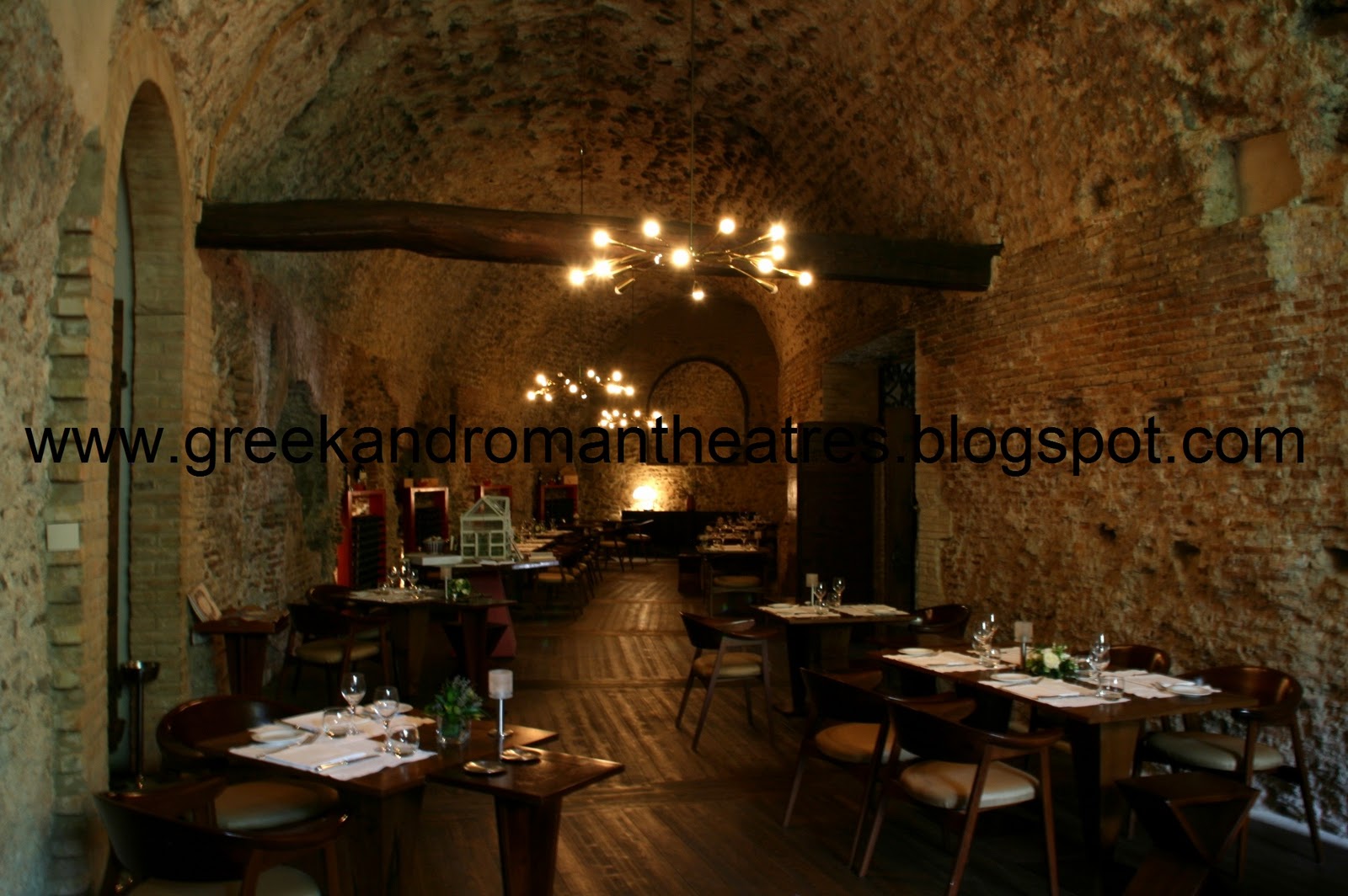
OUT OF PRINT: These theatre is the one I would like to come back with my friend Fran, I am sure he would love it, so dedicated to you, Fran. I have been in theatres that now are an olive grove, or are part of private garden, or are in the meddle of a cornfield or in the meddle of a desert island, or in the corner of a bombed city, I have been in theatres that are underground... but Bevagna one is special... now, the ambulacrum is part of a marvellous restaurant, while you eat its wonderful stew and drink a good wine you can hear through the tunnel of time invisible people getting excited to the next play.

Sunday, 11 September 2011

Scolacium (Squillace)

SCOLACIUM (Squillace), ancient Regio III, modern Italy.

COORDINATES: 38º48’24.61’’N // 16º35’40.71’’E
TIPOLOGY: Roman theatre.
DATE: I A.D. (Julio-Claudian dinasty)
TRANSFORMATIONS: II a.D. (Hadrianic times) in sacaenae frons, podium in media cavea and analemma.
CAPACITY: 3.500 spectators.
CAVEA: Facing West-South-west. 60 m. diameter.  Rest partially on natural slope. Ima cavea was divided in 5 cunei with 6 scalaria, 8 rows of seat are preserved. It has a podium maybe for a statue. Summa cavea rest on two radial corridor vaults, it had 14 or 16 rows of seats.
ORCHESTRA: 19,5 m. including balteus. 3 steps for bisellia.
STAGE BUILDING: Sacenae frons with three doors, all of them in semicircular niches. Proscaenium was rectilinear, 0,85-1 m. high.
LOCATION: Ancient Scolacium is close to modern Roccelletta. The ancient roman theatre is west from forum.
MY BEDSIDE TABLE: Tosi, Giovana; “Gli edificio per spettacoli nell’Italia romana”. Roma, Quasar, 2003. // Courtois, Catherine; “Le bâtiment de scène des théâtres d’Italie et de Sicile”. Providence, Louvain-la.Neuve, 1989. // Sear, Frank; “Roman theatres: an architectural study”. Oxford University Press, 2006. // Ciancio Rossetto, Paola; Giuseppina Pisani Sartorio (eds); “Teatri Greci e Romani: alle origini del linguaggio rappresentato”. Rome: SEAT, 1995.


OUT OF PRINT: The ancient theatre is surrounded by a fence. When you see an exotic animal in a cage you feel sad... you look something extraordinary, unusual but you look at too an indissoluble distance... like a virtual reality. Scolacium ancient theatre is that, of course I understand heritage conservation... but it´s sad, something you can only look at , in the distance, no possibility of touch, like a sacred exotic animal in a jail, a broken animal.