The Silence Stages

Since 2005 I have been visiting more than 430 ancient greek and roman theatres around 18 countries, taking photographs and information. These blog is dedicated to all that experience.


Desde 2005 he visitado más de 430 teatros y odeones, griegos y romanos en 18 países, tomando fotografías y recopilando información. Este blog está dedicado a toda esta experiencia.


Showing posts with label Israel. Show all posts

Tuesday, 5 February 2013

Dora (Dor)


DORA (Dor), ancient Palestina, modern Israel.
COORDENATES: 32º37’12.06’’N // 34º55’07.48’’E
TIPOLOGY: Roman theatre. Urban.
DATE: II or III A.D.
TRANSFORMATIONS:
CAPACITY:
CAVEA: Facing north-north-west. 60 m. diameter. Aditus maximi visible remains.
ORCHESTRA: Paved in stone.
STAGE BUILDING: Columns remains of grey and coloured marble. Corinthian capitals found.
LOCATION: 200 m. north of northern edge of town. Dor is 60 klm. north from Tel Aviv.
MY BEDSIDE TABLE: Segal, Arthur; “Theatres in Roman Palestine & provincia Arabia”. New York, E.J. Brill., 1995. // Sear, Frank; “Roman theatres: an architectural study”. Oxford University Press, 2006.// Ciancio Rossetto, Paola; Giuseppina Pisani Sartorio (eds); “Teatri Greci e Romani: alle origini del linguaggio rappresentato”. Rome: SEAT, 1995.


OUT OF PRINT: Somebody that I found in my visit to ancient Dora told me that the ancient theatre remains are actually the private WC of the bathers... well some latin comedy was always full of eschatology.

Thursday, 5 January 2012

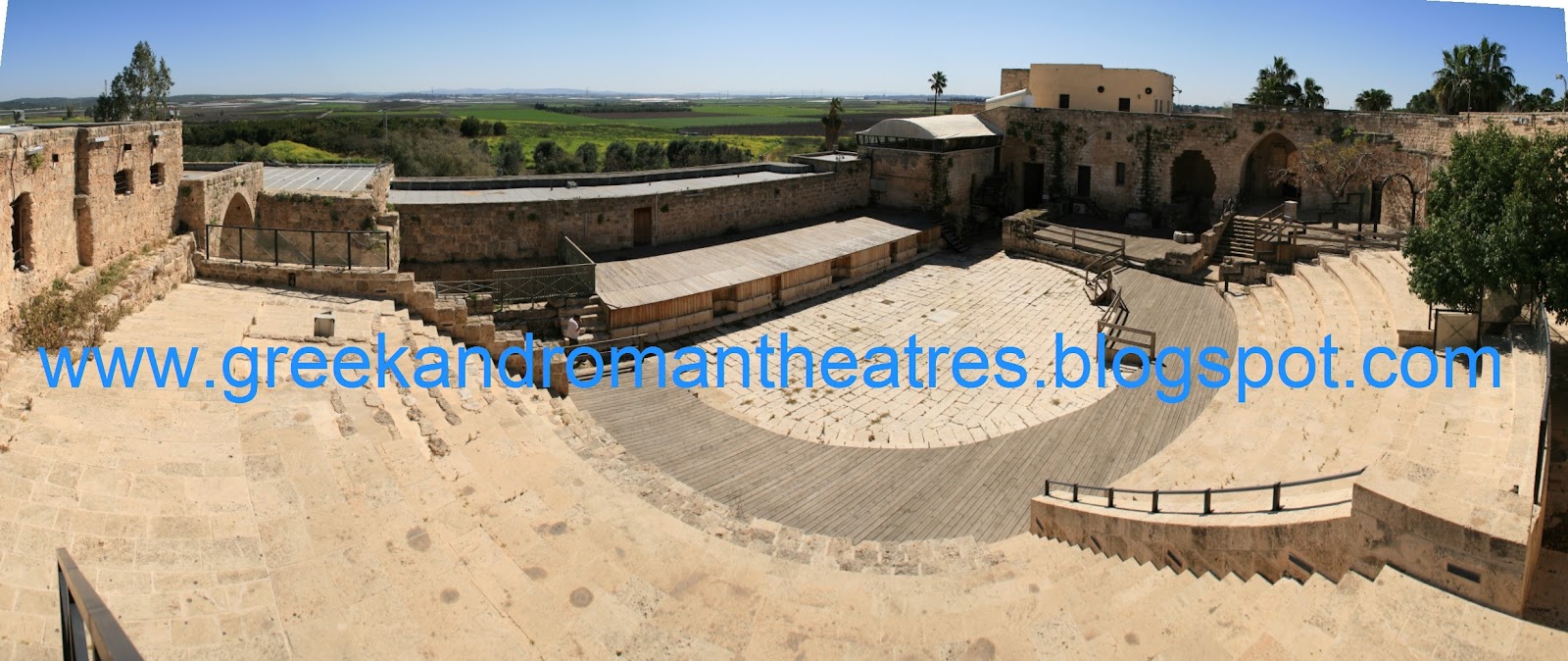
Mamas (Shuni)

MAMAS (Shumi), ancient Arabia, modern Israel.

COORDINATES: 32º32’04.86’’ N // 34º56’53.78’’ E
TIPOLOGY: Roman cult theatre. Not urban.
DATE: II or III A.D.
TRANSFORMATIONS: In byzantine period.
CAPACITY: 1.000 spectators.
CAVEA: Facing east. 60 m. diameter. Probably two maeniana: Ima cavea with probably 11 rows of seats in 4 cunei; summa cavea unknown.
ORCHESTRA: 26 m. diameter including subsellia, without it 19,5 m. diameter.
STAGE BUILDING: Proscaenium had semicircular an rectangular niches. Stage building was 35x10 m. Postcaenium had a pool for ritual purpose.  
LOCATION: 5 klm. north-east from ancient Caesarea. 52 klm. north from Tel Aviv.
MY BEDSIDE TABLE: Segal, Arthur; “Theatres in Roman Palestine & provincia Arabia”. New York, E.J. Brill., 1995. // Sear, Frank; “Roman theatres: an architectural study”. Oxford University Press, 2006. // Ciancio Rossetto, Paola; Giuseppina Pisani Sartorio (eds); “Teatri Greci e Romani: alle origini del linguaggio rappresentato”. Rome: SEAT, 1995.


 OUT OF PRINT: Although the morning I visited Shumi´s ancient theatre it was cold, I do the way of the lizard, looking for the sun in the seats; the hot of the sun always invite me to read, to taste the silences of the book. I remember I was reading a play of a Israeli writer, Hanoch Levin, the play was The Whore from Ohio; not a Plauto´s comedy or a Greek tragedy, but for my personal cosmogony, somehow, after my stay in Israel, Levin is also a classic. I do not know what did the stone steps thought about my reading, maybe they were agree too, but my applause sounded poor for a so beautiful place. I like Hanoch Levin.

Sunday, 8 May 2011

Gadara (Hamat Gader)

GADARA (Hamat Gader), ancient Arabia, modern Israel.
 

COORDINATES: 32º41’00.86 N // 35º39,55.99 E
TIPOLOGY: Roman ritual theatre. Not-urban.
DATE: First half III A.D.
TRANSFORMATIONS:
CAPACITY: 1.500 spectators.
CAVEA: Facing north-east . 35 m. diameter. Maenianum: It had two maeniana although only 15 rows of seats are preserved from ima. Summa cavea was probably suported by aggestus.

ORCHESTRA: 26,20 m. diameter, paved in basalt.

STAGE BUIDING: Pulpitum was 29,6 x 5,8 m. There are visible remains.
LOCATION: Theatre is in a sanctuary, 200 m. north-east from baths. 3,3 klm. from ancient Gadara (in modern Jordan); 20 klm. south-east from Tiberias.
MY BEDSIDE TABLE: Segal, Arthur; “Theatres in Roman Palestine & provincia Arabia”. New York, E.J. Brill., 1995. // Sear, Frank; “Roman theatres: an architectural study”. Oxford University Press, 2006. // Ciancio Rossetto, Paola; Giuseppina Pisani Sartorio (eds); “Teatri Greci e Romani: alle origini del linguaggio rappresentato”. Rome: SEAT, 1995. 


OUT OF PRINT: When I was in 2008 in ancient Gadara, in modern Jordan, I could only visit two of the three theatres the city had. I peered into the valley trying to identify the sanctuary where the third theatre is located, 3 klm. down from Gadara. It was frustrating to know that I could not see it because, although I could almost touch it with my hand the third Gadara´s theatre is in Israel. In 2011, I traveled to Israel, when I could finally visit the enigmatic theatre of Hamat Gader, the third theatre of ancient Gadara I look up, to the hill, to the Jordan side, and I felt the urge to return to the theatres of Gadara... I will never know if the soldiers would have understood my reasons... I think borders do not know about dialoguing rules... Gadara, an ancient break city... to walk three kilometers I had to wait three years and give a round of thousands... so many questions without answers...

Friday, 25 March 2011

Tiberiades (Tiberias)

TIBERIADES (Tiberias), ancient Galilea / Palestina, modern Israel.

COORDINATES: 32º46’25.48 N // 35323899 E
TIPOLOGY : Roman theatre. Urban.
DATE: First I A.D.
TRANSFORMATIONS: II and IV A.D.
CAPACITY: 6.000 spectators.
CAVEA: Facing north-west. 78 m. diameter. Maenianum: Probably had three maeniana. Four rows survives in ima cavea but there are remians of at least  another three. It is very surprising the colour of the rows, forming a checkboard of limestome and basalt.
ORCHESTRA: 20 m. diameter.
STAGE BUILDING: 6 x 30 m.
LOCATION: North of cardo, south-east of ancient Tiberiades.
MY BEDSIDE TABLE: Murphy-O’Connor; The Holy Land: An Oxford Archeological Guide from earliest times to 1700”. Oxford University Press, 2007. //Walid Atrash: http://www.hadashot-esi.org.il/report_detail_eng.asp?id=1381&mag_id=117


OUT OF PRINT: On Monday I had the luck of visiting ancient Tiberias theatre, Walid Athrash and Avner Hillman the archaeologist who has conducted the excavations kindly invited me. Avner showed me with all details and explained me the excavations, showing at any time a big passion and love in the work he is doing; it was marvellous for me listen to him all the explains about the history of the theatre, how the earthquakes had affected the structure by two times, from where it came the basalt stone of the place. Listening him I felt  he and Walid and all the people was working in the theatre were like sculptors who are working in the air, cleaning of impurities an idea of beauty, returning to life the lifeless skeleton of history, returning back to the theatre, sixteen centuries after, a big silence applause. Thanks Avner an Walid for your generosity, thanks for sharing your passion.