The Silence Stages

Since 2005 I have been visiting more than 430 ancient greek and roman theatres around 18 countries, taking photographs and information. These blog is dedicated to all that experience.


Desde 2005 he visitado más de 430 teatros y odeones, griegos y romanos en 18 países, tomando fotografías y recopilando información. Este blog está dedicado a toda esta experiencia.


Friday, 11 February 2011

Sabratha (Sabratha)

SABRATHA (Sabratha), ancient Tripolitania / Africa Proconsularis, modern Libya.

COORDINATES: 32º48’19.50” N // 12º29’06.77” E
TIPOLOGY : Roman theatre. Urban.
DATE: Last II –First III A.D.
CAPACITY: 6.000 spectators.
CAVEA: Facing north. 92,6 m. diameter. Built on level ground, but rested on a plataform rock. Maenianum: Ima cavea with 11 rows of seats in 6 cunei; Media cavea with 6 rows and 7 cunei; Summa cavea with 15 rows in 8 cunei (the extreme ones small).
ORCHESTRA: 25 m. diameter (including balteus and four steps for bisellia. Paved on whit marble.
STAGE BUILDING: Proscaenium niches (3 curved and 4 rectangular) has a marvellous and very well preserved relief sculptures (Muses, Satyrs, Graces and Judgment of Paris are the motifs. Scaenae frons, like other theatre parts have been restored, the corinthian columnatio  has three storeys (21 m. high)
LOCATION: Sabratha is 65 klm. west of Tripoli.
MY BEDSIDE TABLE: Caputo, Giacomo; “Il teatro di Sabratha”. Roma, l’Erma di Bretschneider, 1959. // Sear, Frank; “Roman theatres: an architectural study”. Oxford University Press, 2006. // Ciancio Rossetto, Paola; Giuseppina Pisani Sartorio (eds); “Teatri Greci e Romani: alle origini del linguaggio rappresentato”. Rome: SEAT, 1995. // Bieber, Margarete. “The History of The Greek and Roman Theatre”. Princeton University Press, 1961. // Di Vita, Antonio; Di Vita-Evrard, Ginette; Bacchielli, Lidiano; “Libia antigua”. Barcelona, Könemann, 1999. // Dal Bosco, Oriana; Grassi, Maria Teresa; “Mediterranean and Roman Libya”. Firenze, Polaris, 2005. // Haynes, D.E.L.; “The antiquities of Tripolitania”. London, Darf.


OUT OF PRINT: What to say about these ancient theatre... I spent some hours, fascinated with its remains. I sat down in the inma cavea and wait for a long time for the actors; I called them, encouraging them to start, like children do when they want the play start... some hours passed... and nobody acted these day, only the echo of the wind, mimicking the sound of the seashell... only the shadows projected of some clouds clueless, lonely, like me that day in the wilds of ancient Libya, that evening in which the only act was the acting of the shadows.

Wednesday, 9 February 2011

Saepinum (Sepino)

SAEPINUM (Sepino), ancient Regio IV Samnium et Sabina, modern Italy.

COORDINATES: 41º26’03.99” N // 14º37’02.85” E
TIPOLOGY : Roman theatre. Urban.
DATE: First I A.D. (Augustan)
TRANSFORMATIONS: Scene building in IV.
CAPACITY: 3.000 spectators.
CAVEA: Facing south-east. 61,5 m. diameter. Maenianum: Ima cavea had 10 rows of seats divided in four cunei, five rows of them (three complete) survives; Summa cavea: probably had 7 rows of seats.
ORCHESTRA: 23 m. diameter including balteus and three steeps of bisellia.
STAGE BUILDING: Proscaenium had three curved and two rectangular niches. Scaenae frons was rectilinear. Pulpitum was 40,3 x 8,7 m.
LOCATION: Sepino is 50klm. north-west of Benevento.
MY BEDSIDE TABLE: Tosi, Giovana; “Gli edificio per spettacoli nell’Italia romana”. Roma, Quasar, 2003. // Courtois, Catherine; “Le bâtiment de scène des théâtres d’Italie et de Sicile”. Providence, Louvain-la.Neuve, 1989. // Maggi, Stefano; Troso, Cristina. “Guida all’Italia archeologica”. Casale Monferrato, Piemme, 2007. // Sear, Frank; “Roman theatres: an architectural study”. Oxford University Press, 2006. // Ciancio Rossetto, Paola; Giuseppina Pisani Sartorio (eds); “Teatri Greci e Romani: alle origini del linguaggio rappresentato”. Rome: SEAT, 1995.


OUT OF PRINT: Who would not like to leave there? Sepino´s ancient theatre is surrounded by opening the window every morning and find these view... the ancient theatre. In the photo you can see the house built in the scene building place, but at the back some old houses surrond all the cavea. I spend a lovely evening there, experiencing a very special silence, imagine all the common life around the theatre, children playing, clen clothes drying in the sun, elderly people talking in the row of seats, the smell of the food scaping from the windows... all the life flowing aroun the ancient theatre... it remains me something, the name of one of my favourites music recordings: “All the world is a stage”, by Rush.

Sunday, 6 February 2011

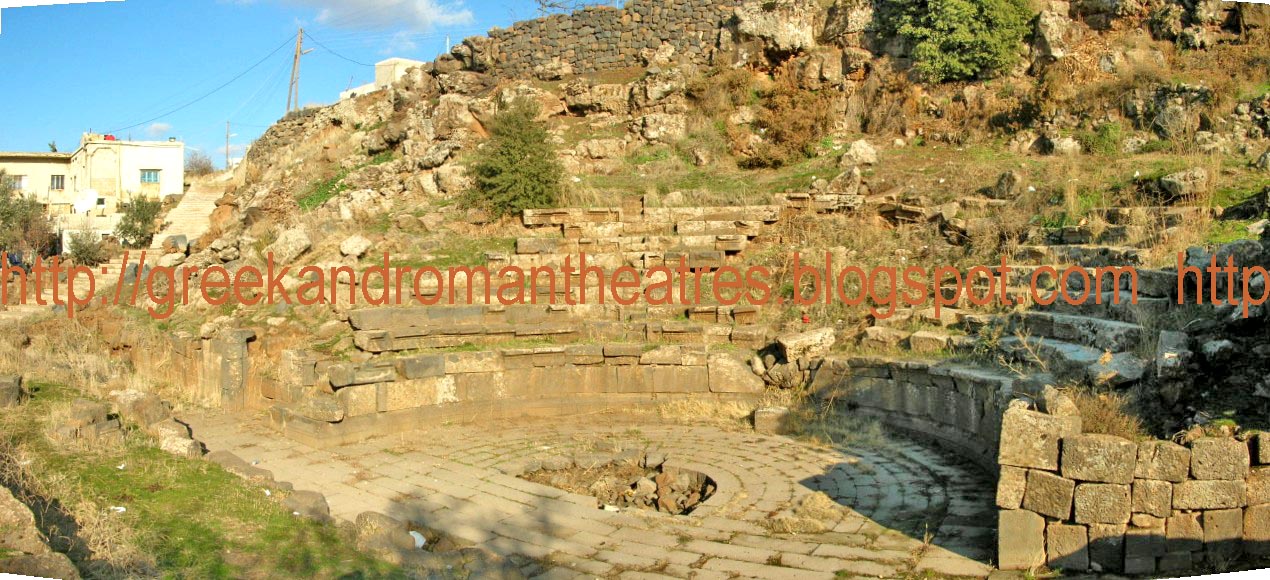
Canatha (Qanawat)

CANATHA, ancient Arabia, modern Syria.

COORDINATES: 32º45’21.99” N // 36º37’08.25” E
TIPOLOGY : Roman cult theatre. Not urban ¿?
DATE: Second half II A.D.
TRANSFORMATIONS:
CAPACITY: 800 ¿? spectators.
CAVEA: Rest on natural hill, carved into the rock. 46 m. Diameter. Facing west. Ima cavea: 3 cunei and 9 steps survives, but it was bigger.
ORCHESTRA: 12 m. diameter. Paved in cut stones.
STAGE BUILDING: The proscaenium shows three curved and two rectangular niches.
LOCATION: Close to the nymphaeum, in the eastern banks of the wadi. Modern Qanawât is 5 klm north-east of Suwayda.
BEDSIDE TABLE: Sear, Frank; “Roman theatres: an architectural study”. Oxford University Press, 2006. // Ciancio Rossetto, Paola; Giuseppina Pisani Sartorio (eds); Teatri Greci e Romani: alle origini del linguaggio rappresentato. Rome: SEAT, 1995. // Segal, Arthur; “Theatres in Roman Palestine & provincia Arabia”. New York, E.J. Brill., 1995. // Burns, Ross; “Monuments of Syria”. London, I.B. Tauris, 1999. // Abou Assaf, Ali; “The archaeology of Jebel Hauran”. Damascus, Sidawi, 1998.


OUT OF PRINT: Marcus Ulpius Lysias Icarius paid 10.000 denarii fot its construction. The building was never covered so we can not say it is really an odeon. Probably a typical west cult theatre. Canatha is in the south of Syria, in the Hauran plain; in a very short distances you can visit six ancient theatres. Hauran plain reminds me to Castilla, where evenings seems to be caught in the sun. Is etched in my mind, that fire sunset, from Hauran to Damascus, eating spinach pie and blaklava.

Saturday, 5 February 2011

Mylias (Kocaaliler)

MILYAS / MELLI (Kocaaliler), ancient Pisidia – Asia Minor, modern Turkey.


COORDINATES: 37º18’20.23” N // 30º45’02.35” E
TIPOLOGY : Greek theatre. Urban.
DATE:  Hellenistic.
TRANSFORMATIONS:
CAPACITY: 1.000 spectators.
CAVEA: Facing north-east. Carved on rock. Only one maeniana, 13 rows of seats in 5 cunei.
ORCHESTRA:
STAGE BUILDING: Wall of stage buildibg survives in good condition, not excavated yet.
LOCATION: Ancient Milyas is 2 klm. south-east from modern village of Kocaaliler, up in a mountain. The theatre is not easy to find because the ancient city is under vegetation. Kocaaliler is 50 klm. north from Antalya.
MY BEDSIDE TABLE: Yilmaz, Yasar; “Anadolu Antik Tiyatrolari”. Istanbul, Yem Yanin, 2010.


OUT OF PRINT: The evening I arrive Milyas was rainig. I did not know exactly the position of the ancient theatre, only the hill were it was the Greek town. Walking through the remains was dificult, the old city was covered by bushes and a lot of rolling stones under them made my ankles very fragile and sore. I was more than one hour touring the hill but did not find the theatre. When I dicided to turn back beacuse the day was getting dark I saw a man in a high cliff. I said him “Merhaba, tiyatro” and he signed me behind him. I followed him and I could discover the theatre hidden among the rocks, the show was wonderful, a theatre tucked into the rock´s embrace. The turkish man was the guard of the archeological remains, in every ancient turkish city there are a guard, they do not spend the day in the remains, the archeological place usually is open-air, no supervision... well that seems to be but the guards always appear, you do not know how but they appear... a real mistery, in the middle of nothing... but they are there... and that time great for me... he showed me the theatre, a really hypnotic place; take notice of the landscape you can see from the cavea.

Wednesday, 2 February 2011

Typaneae - Aepium (Kastro Platiana)

TYPANEAE - AEPIUM (Kastro Platiana), ancient Elide / Achaia, modern Greece.

COORDINATES: 37º32’25.26” N // 21º45’07.90” E
TIPOLOGY : Greek theatre. Urban.
DATE: IV B.C.
TRANSFORMATIONS: Stage building late II B.C.
CAPACITY: 500 ? spectators.
CAVEA: Facing north. 34,50 m. diameter. There are remains of nine rows of seats.
ORCHESTRA: One honor stone seat survives who bordered the orchestra.
STAGE BUILDING: Remains are from after 145 B.C. The stage complex is part of the wall, like Nea Pleuron´s ancient theatre.
LOCATION: In a mountain, up from modern village of Platiana, in Peloponnesus. Platiana is 35 klm. south-east from Pyrgos.
MY BEDSIDE TABLE: Sear, Frank; “Roman theatres: an architectural study”. Oxford University Press, 2006. // Ciancio Rossetto, Paola; Giuseppina Pisani Sartorio (eds); “Teatri Greci e Romani: alle origini del linguaggio rappresentato”. Rome: SEAT, 1995.


OUT OF PRINT: The site of ancient Typaneae has a real great view over Elide and Achaia land. The remains are not very good, but it´s easy to view the analemma, some row of seats and the stage complex foundations... in that  bleakness there are something special, one honor stone seat, one of those who bordered the orchestra is ancient times, reserved seats for priests... it´s really surprising , so little remains but one honor of seat well preserved, the ghost of a priest still dismiss the sunset every evening, since twenty-four centuries ago. You can feel it, a silence lover. In photograph you can see the stage complex that is part of the wall at left; on your right the analemma; honor seat is in the middle of photograph, a little right, yo can see how projects a little shadow